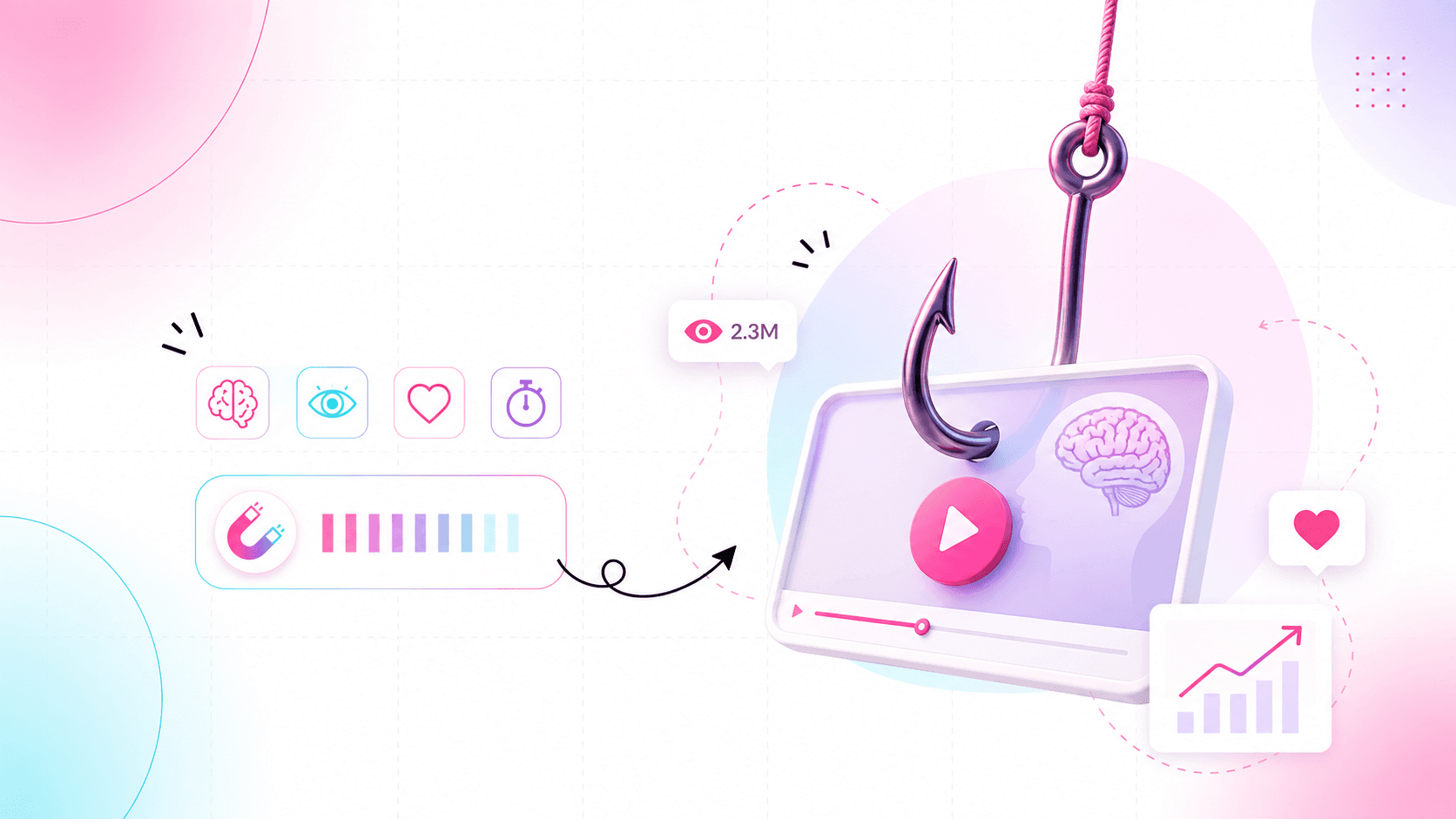
The Psychology of Viral Video Hooks: How to Stop the Scroll
You have a fraction of a second to convince a user not to swipe past your video.
If your TikTok, Reel, or YouTube Short fails to capture attention immediately, the algorithm will kill its reach, regardless of how good the rest of the video is. But capturing attention isn't about yelling at the camera or using cheap clickbait. High-performing hooks are rooted in behavioral psychology.
If you want to predictably increase your views, you need to understand Interrupt Theory.
Interrupt Theory is the concept of forcing a viewer to pause their scrolling by triggering an involuntary orienting response in their brain. You must break their scrolling trance with a pattern interrupt.
Here is the exact psychological framework behind the internet's most successful video hooks, and how you can apply it to your own content.
The 4 S’s of Hookwriting
To effectively trigger that orienting response and stop the scroll, every hook you write must contain four key ingredients.
- Subject: You must clearly define who or what the video is about within the first second. If the viewer is confused, they swipe.
- Stakes: Give the viewer a compelling reason to care. What is the outcome? What is the curiosity-inducing scenario? There must be tension.
- Speed: Deliver the message with high compression. Use the fewest words biologically possible without losing clarity.
- Simplicity: Ensure the hook can be interpreted in exactly one way. Vague, artistic setups do not work in short-form video.
Bad Hook (Fails the 4 S's): "Today I want to talk about this really cool software I found that helps with marketing." (Slow, low stakes, vague).
Great Hook (Passes the 4 S's): "This AI tool replaces your entire social media team for $10." (Clear subject, high stakes, fast, simple).
The Triple Hook Method
Rookies think a hook is just the first sentence of their script. Experts know that a viral hook is actually three different hooks working in alignment at the exact same time.
To maximize retention, you must master the Triple Hook Method:
1. The Text Hook (The Anchor)
This is the most critical component of your video. The text hook is the physical text overlay on the screen during the first 3 seconds.
- It should be limited to 1–2 lines max.
- It must use specific, high-leverage power words (e.g., "Scientifically impossible," "Cheat code," "Forbidden").
- It acts as the anchor for the viewer's eyes while their brain processes the audio.
2. The Spoken Hook (The Delivery)
This is the verbal delivery of your script. The best spoken hooks rely on data-backed formats. Instead of copying a competitor's hook verbatim, remix their successful power words into your niche. If a finance creator goes viral saying, "The hidden tax trap destroying your savings," a fitness creator can remix that into, "The hidden diet trap destroying your metabolism."
3. The Visual Hook (The Pattern Interrupt)
While often treated as the least important, visual hooks are the secret weapon of elite creators. You need movement or a subtle shift in the frame to trigger the brain's orienting response.
- Drop an item on a desk.
- Walk into the frame.
- Use a sudden, abrupt zoom (punch-in) on the first beat of the audio.
Surviving the "Lock-in Zone" (Seconds 3 to 10)
Your hook worked. The viewer stopped scrolling. But your job isn't done.
The next 5 to 10 seconds of the video are called the Lock-in Zone. If you lose the viewer here, your retention graph will look like a cliff dive, and the algorithm will stop pushing the video.
To survive the Lock-in Zone, you must do three things immediately:
- Confirm the hook's claim: Do not pivot to an unrelated topic. Immediately validate that the video will deliver exactly what the text hook promised.
- Establish rapid trust: Earn the viewer's belief through your packaging, your pacing, and your tonality.
- Provide concrete proof: This is the most important step. Before you explain how to do something, prove that you can. Flash a screenshot of data, show a before-and-after case study, or present visual evidence that backs up your opening claim.
Stop Guessing. Start Engineering Hooks.
Writing high-performing hooks shouldn't be a guessing game. The best creators don't rely on sudden bursts of inspiration—they analyze what is currently working in the algorithm and reverse-engineer the psychology.
This is exactly why we built HookClone.
HookClone allows you to analyze successful viral videos in your niche, automatically extracting the Text Hooks, Spoken Hooks, and Visual Hooks that drove their success. Instead of manually trying to decode the psychology of a competitor's video, HookClone turns their winning formula into a reusable template for your own content.
Stop starting with a blank page. Master the psychology of attention, and let HookClone give you the blueprints to execute it.