The Psychology Behind Viral Hooks, Why We Can’t Stop Watching
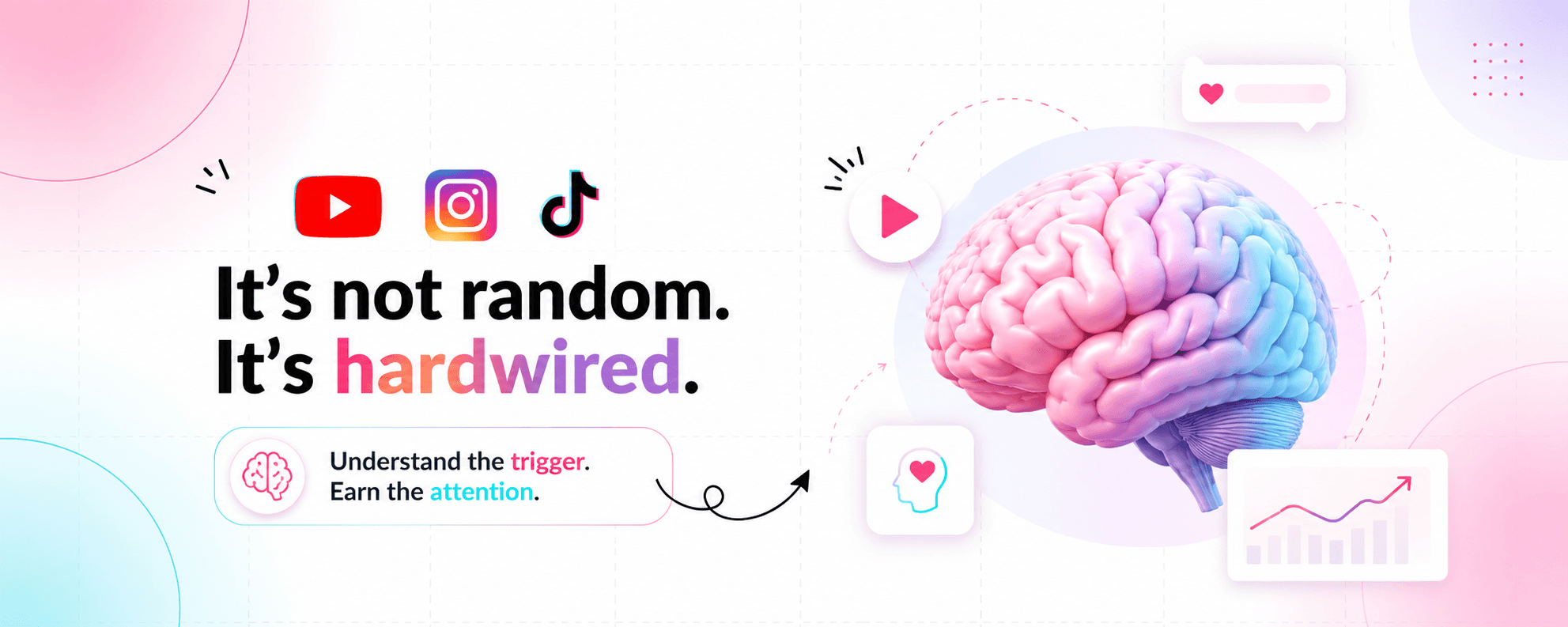
Viral hooks do not rely on luck; they rely on human neurology. A successful hook bypasses the logical brain and triggers an immediate instinctual response, usually curiosity, fear of missing out, or dopamine anticipation. If you understand the psychology of attention, you can engineer hooks that mathematically force people to stop scrolling.
Here is the exact psychology behind why certain videos capture millions of views, and how you can weaponize these triggers for your own content.
Why Hook Psychology Matters
When a user opens TikTok or Instagram Reels, their brain is in a state of passive consumption. Their Reticular Activating System (RAS), the part of the brain responsible for filtering out unnecessary information, is working in overdrive to ignore boring, irrelevant content.
To get a view, you have to break through the RAS.
If your hook appeals to logic ("Hello, today I will teach you about software"), the RAS filters it out as boring, and the thumb swipes away. If your hook appeals to a survival instinct, a deep desire, or an unanswered question, the brain physically compels the thumb to stop. You aren't just fighting an algorithm; you are fighting human biology.
Examples: Logical vs. Psychological Hooks
Notice how the psychological hooks below trigger an immediate emotional response, while the logical hooks feel like a lecture.
The B2B SaaS Niche:
- Logical: "Here are three ways to improve your email marketing." (Boring, ignorable).
- Psychological (Loss Aversion): "You are losing 30% of your free trials because your onboarding email does this." (Triggers fear of lost revenue).
The Fitness Niche:
- Logical: "Here is a tutorial on how to do a proper bicep curl." (Generic, low urgency).
- Psychological (Curiosity Gap): "Stop doing your bicep curls like this if you want your arms to actually grow." (Implies the viewer is making a mistake they must correct).
The 4 Psychological Triggers Framework
To reliably beat the swipe, build your hooks around one of these four psychological frameworks:
1. The Pattern Interrupt
The human brain is built to recognize patterns and ignore the predictable. A pattern interrupt does the exact opposite of what the brain expects.
- Execution: Whisper instead of shouting. Drop your phone. Start the video mid-sentence. Visually disrupt the viewer's feed so their brain has to pause to process what just happened.
2. The Curiosity Gap
Coined by behavioral economist George Loewenstein, the curiosity gap is the mental itch created when you give someone just enough information to make them realize they are missing something important.
- Execution: "This one hidden iPhone setting is draining your battery." The brain demands closure, forcing the user to watch until the setting is revealed.
3. Loss Aversion
Psychological studies prove that humans feel the pain of losing something twice as intensely as the pleasure of gaining something.
- Execution: Instead of promising a benefit ("How to get more views"), frame the hook around avoiding a negative outcome ("Why your videos are stuck in 200-view jail").
4. The "Me Too" Effect (Identity Validation)
People love feeling understood. If you perfectly articulate a highly specific, niche problem, the viewer feels a chemical hit of validation.
- Execution: "POV: You're a social media manager trying to explain to your boss that a 10-minute corporate video won't go viral on TikTok."
Common Mistakes When Using Psychological Hooks
- Creating Clickbait (Breaking the Promise): If you use a powerful Curiosity Gap hook, you must deliver the answer in the video. If you trick the viewer, they will drop off at second 5, your retention will tank, and the algorithm will kill the video.
- Ignoring Visual Psychology: A great script is useless if the visual is boring. Your text hook and visual hook must work together. If you are talking about a mistake, show a visual representation of that mistake instantly.
- Being Too Clever: Confusion kills retention. If your hook is too complex or takes too long to process, the brain takes the easy way out and swipes to the next video. Keep it at a 5th-grade reading level.
Action Steps
- Identify your audience's deepest pain point: What is the one thing keeping them up at night?
- Apply the Loss Aversion framework: Write three different hooks that agitate that specific pain point.
- Add a Pattern Interrupt: Pair your script with a sudden visual movement in the first 1.5 seconds of the video.
Decode the Psychology of Your Competitors
Understanding the psychology of a hook is one thing; consistently coming up with winning ideas is another. The fastest way to master psychological hooks is to study the ones that are already working.
This is exactly what HookClone does.
HookClone analyzes viral videos in your niche and breaks down their underlying structure. It strips away the fluff and reveals the psychological formulas, the pattern interrupts, the curiosity gaps, and the pacing, that your competitors are using to capture millions of views.
Don't start from scratch. Find the psychological triggers that are already proven to work, turn them into your own templates, and start creating content that the human brain can't ignore.