How to Analyze Competitor Reels and Replicate Their Success
Every creator and marketer has experienced this exact scenario: You spend hours scripting, shooting, and editing an Instagram Reel. You post it, and it flatlines at 200 views. Meanwhile, a competitor posts a video in the exact same niche, and it pulls in 1.5 million views.
What do they know that you don't?
The difference isn't luck, and it usually isn't production quality. The difference is structure. The creators winning on short-form platforms today aren't guessing—they are actively monitoring what works, breaking down the mechanics of viral videos, and adapting those formulas for their own accounts.
If you want to stop praying to the algorithm and start predictably driving views, you need a system to analyze competitor Reels. Here is exactly how to reverse engineer successful short-form video content and turn those insights into winning templates.
Why "Just Watching" Competitor Reels Doesn't Work
Scrolling through your competitor’s feed and thinking, "Oh, that's a cool transition," is not competitor analysis.
When you passively watch content, you get distracted by the payload (the actual information or entertainment). To reverse engineer a video, you have to look past what they are saying and analyze how they are saying it.
You need to track the hidden architecture:
- The Hook: What happens in the first 3 seconds?
- Visual Pacing: How often does the camera angle or visual element change?
- Retention Mechanics: How do they keep you watching until the end?
- The Format: Is it a talking head, green screen, or voiceover over B-roll?
The 4-Step Framework to Reverse Engineer Viral Reels
To turn a competitor’s viral hit into a predictable framework you can use, follow this four-step breakdown.
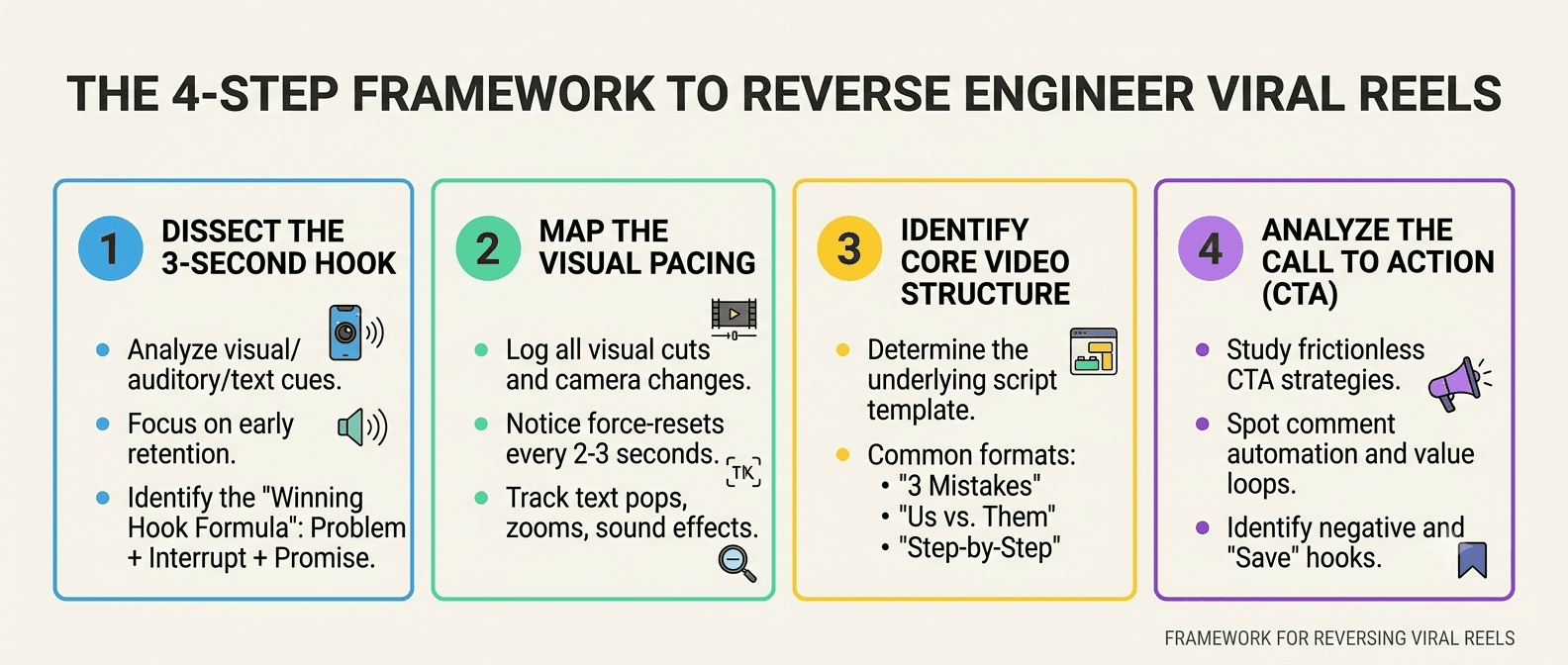
Step 1: Dissect the 3-Second Hook
The algorithm only cares about one thing: retention. And retention is entirely dependent on the hook. If a competitor’s video has millions of views, it has a high-converting hook.
Analyze both the visual hook and the auditory/text hook:
- Visual: Are they moving? Is there an unexpected object in the frame? Are they pointing at text? (e.g., A UGC creator drops a product on a table to create an immediate pattern interrupt).
- Auditory/Text: What is the specific promise made?
The Winning Hook Formula:
Most high-performing competitor Reels follow a specific structural formula in the first three seconds:
Problem + Pattern Interrupt + Promise
Example: "Tired of spending hours editing? (Problem) Throws laptop on couch (Pattern Interrupt). Here is the 5-minute workflow I use instead (Promise)."
Step 2: Map the Visual Pacing
Viral videos rarely hold on a single static shot for more than 3 to 4 seconds. When you analyze a successful competitor Reel, count the visual changes.
Grab a spreadsheet and track:
- When does the text pop up?
- When do they punch in (zoom) on their face?
- When does a sound effect or B-roll clip play?
You will quickly notice that the most successful UGC ads and creator videos force a visual change every 2 to 3 seconds to reset the viewer's attention span.
Step 3: Identify the Core Video Structure
Once you strip away the specific topic, what is the underlying structure of the video?
Common high-performing structures include:
- The "3 Mistakes" Format: (Hook → Mistake 1 → Mistake 2 → Mistake 3 → CTA)
- The "Us vs. Them" Format: (Hook showing a common bad product → Transition to the competitor's good product → Feature breakdown)
- The "Step-by-Step Tutorial" Format: (Bold claim hook → Step 1 → Step 2 → Proof of result)
When you identify the structure, you can swap out their topic for your own. If a competitor goes viral with "3 Mistakes You're Making With Your Skincare," you can use that exact same pacing and structure for "3 Mistakes You're Making With Your Facebook Ads."
Step 4: Analyze the Call to Action (CTA)
How do they transition from the value payload to the ask? Successful Reels don't beg for engagement. They use frictionless CTAs.
Notice if your competitors are using:
- Comment automation: "Comment 'SYSTEM' and I'll DM you the link."
- Value loops: "Save this video for your next launch."
- Negative hooks: "Don't buy X until you read the caption."
The Faster Way to Analyze Competitors
Historically, doing this level of analysis required a painful manual workflow. You would have to download your competitor's videos, open a spreadsheet, manually transcribe the hooks, time the jump cuts, and try to build your own templates from scratch.
This is exactly why we built HookClone.
Instead of manually logging every transition, HookClone analyzes successful viral videos and automatically turns them into reusable templates. It breaks down the winning hooks, extracts the structural pacing, and gives you a proven framework to drop your own content into.
Whether you are a UGC creator trying to pump out winning ad variations or a founder building an audience, you can skip the spreadsheet and instantly access the DNA of viral short-form videos.
3 Traps to Avoid When Replicating Success
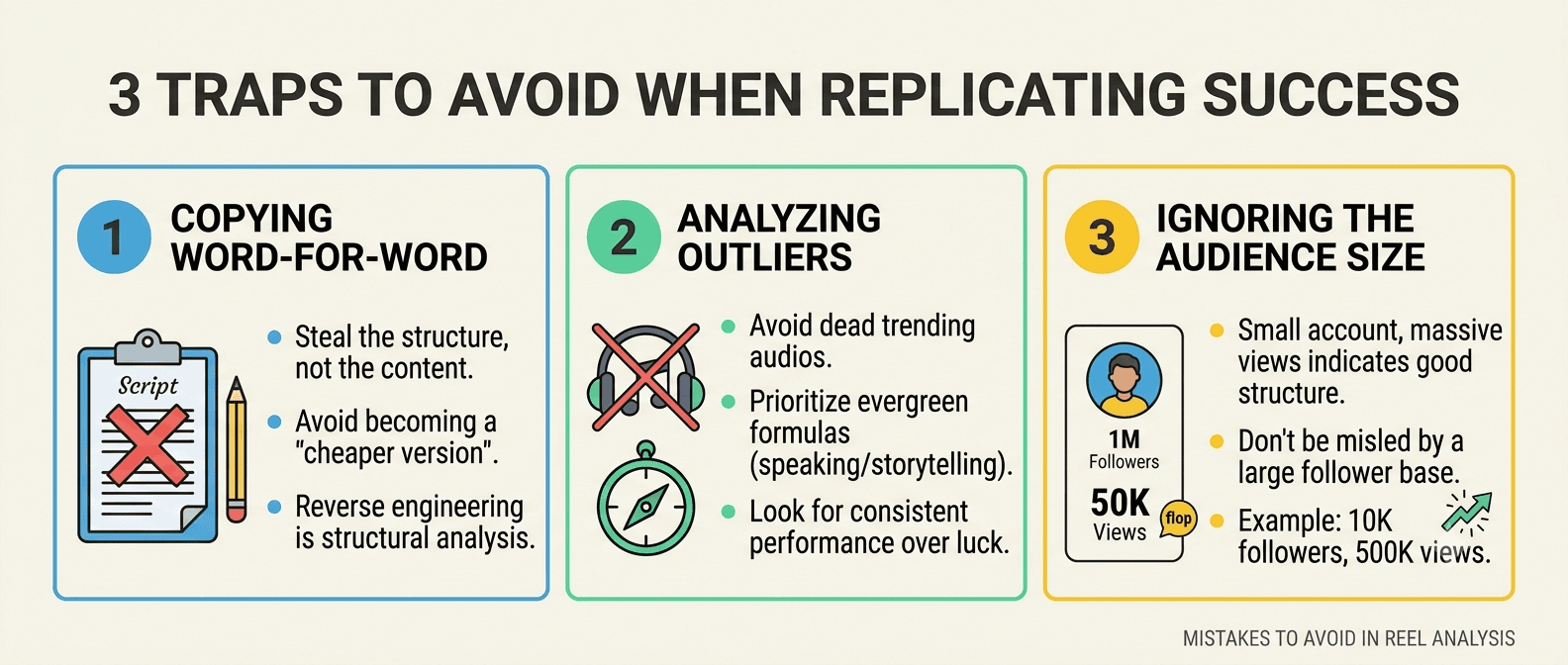
As you analyze competitor Reels, make sure you don't fall into these common traps:
- Copying Word-for-Word: Reverse engineering is about stealing the structure, not the content. If you copy their script exactly, you just become a cheaper version of them.
- Analyzing Outliers: Don't analyze a Reel where the competitor used a trending audio that is now dead. Look for videos that perform well based on speaking and storytelling, as these formulas are evergreen.
- Ignoring the Audience Size: If an account has 1 million followers, a video with 50,000 views is actually a flop. Look for accounts that have 10,000 followers but posted a video with 500,000 views. That means the structure worked so well it broke out of their existing audience.
Build Your Video Creation System
Analyzing competitor Reels is the highest-ROI activity you can do for your social media strategy. By identifying the hooks, pacing, and structures that already hold human attention, you eliminate the guesswork from content creation.
Stop starting from a blank page. Find out what works, extract the formula, and make it your own.