How Instagram's Algorithm Actually Works: The Metrics That Trigger Viral Distribution
Summary
Instagram's algorithm distributes content through a calculated flywheel, starting with an "initial push" to a small test pool of active followers. If your video generates high early engagement, specifically maximizing watch time, DM shares (sends), and saves, it crosses a critical performance threshold. Passing this test triggers a "larger push," prompting the algorithm to broadcast your Reel to non-followers across the Explore and Reels tabs. To scale organic reach consistently, content must be engineered with strong hooks and pacing to satisfy these exact retention and shareability metrics.
Most creators think going viral on Instagram is about luck. It's not. It is a predictable mathematical equation.
Instagram does not randomly push videos to millions of people. It uses a calculated distribution flywheel. It tests your content on a small audience, measures specific behavioral metrics, and if those metrics cross a certain threshold, it opens the floodgates to new audiences.
If you want to reach non-followers and dominate the Reels and Explore tabs, you need to understand the "Initial Push" and the core metrics Instagram actually cares about in 2026.
The Distribution Flywheel: Initial Push vs. Larger Push
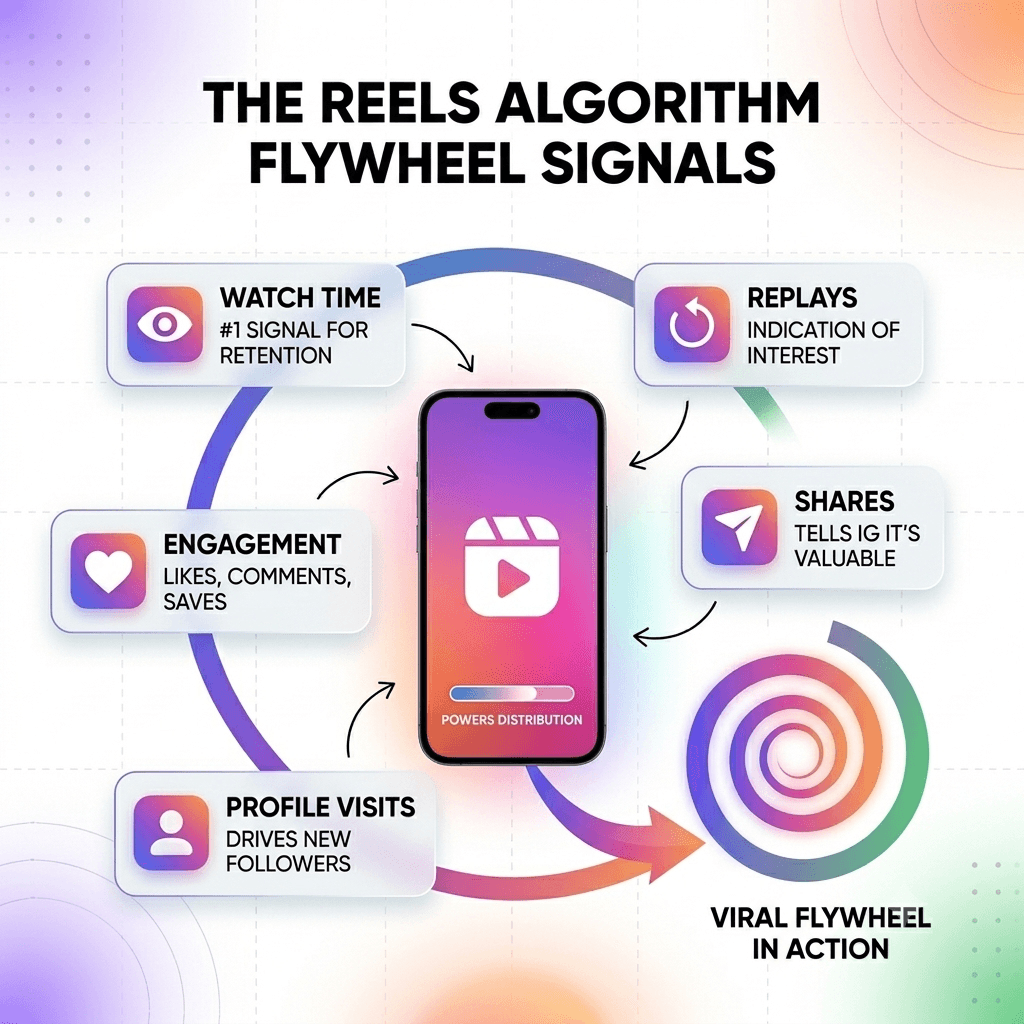
Every time you post, your content goes through a multi-stage stress test.
Phase 1: The Initial Push (The Test Pool)
When you hit publish, Instagram does not show your Reel to everyone. It pushes it to a small initial test pool, typically a fraction of your most active followers and users who have recently engaged with your account.
During this phase, the algorithm is acting like a judge. It is measuring early engagement velocity, how fast people interact with your post in the first 30 to 60 minutes.
Phase 2: The Threshold
Instagram sets baseline performance thresholds for this initial group. It is looking for one thing: Are people staying on the app because of this video?
If your test pool scrolls past your video, the distribution stops. The video dies.
If your test pool stops, watches, and shares, you trigger the next phase.
Phase 3: The Larger Push (Non-Follower Distribution)
When your metrics exceed the threshold, Instagram initiates the larger push. It starts recommending your Reel in the Explore page and the Reels tab to people who do not follow you but have shown interest in similar topics.
The more your metrics hold up at scale, the more Instagram pushes it. This is the viral flywheel in action.
The 4 Metrics Instagram Cares About Most in 2026
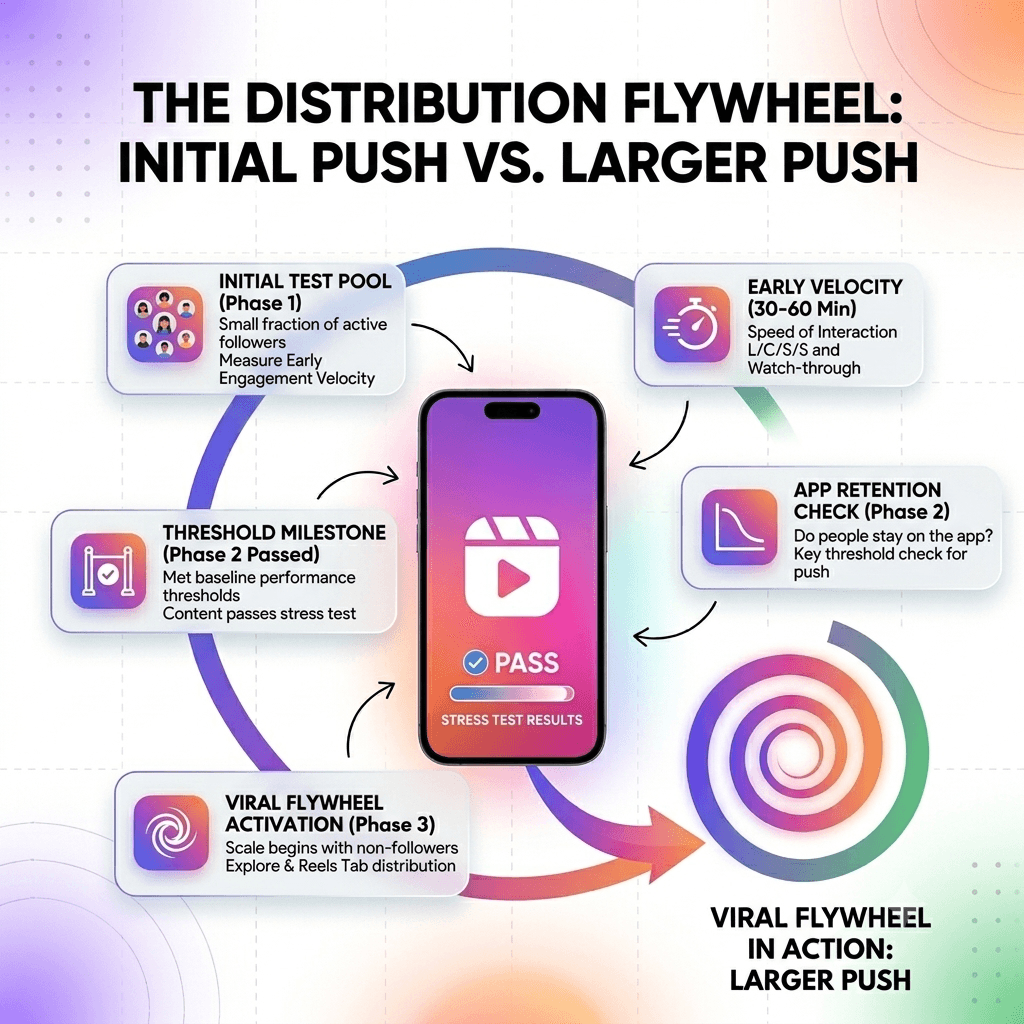
If you want to survive the Initial Push, you must optimize for the exact signals Instagram's ranking systems prioritize. In 2026, Instagram head Adam Mosseri confirmed a major shift in what matters most across all surfaces.
1. Watch Time (The Ultimate Signal)
Watch time is the single most important metric on Instagram. The algorithm measures your retention rate and whether users watch your video all the way through.
- The 3-Second Hook: Your "skip rate" in the first 3 seconds determines your fate. If over 60% of viewers watch past the 3-second mark, Instagram interprets this as a highly engaging video and pushes it wider.
- Re-watches: If a video loops, it sends a massive positive signal to the algorithm that the content holds attention.
2. Sends Per Reach (The DM Effect)
Likes are cheap. Private shares are expensive. Instagram now considers "Sends per reach" (how many people DM your video to a friend) as a top-ranking signal.
A share proves that your content is so valuable or entertaining that someone essentially vouched for it to their personal network. Optimize for sends by creating relatable, contrarian, or highly educational content.
3. Saves (High Intent)
Saves tell the algorithm that your content is worth returning to. This is specifically valuable for the Explore page algorithm. Checklists, actionable tutorials, and deep-dive frameworks naturally generate high saves.
4. Likes and Comments (The Baseline)
Likes and comments still matter, but they are now secondary to Watch Time and Sends. They act as baseline social proof but rarely trigger a viral push on their own. However, conversational depth carries more weight than spammy emoji comments.
Automating Your Metric Analysis
To consistently trigger the larger push, you have to study the videos that are already passing the test. What hooks are keeping viewers past 3 seconds? What visual structures are driving DMs and shares?
Instead of guessing, use HookClone.
HookClone allows you to analyze successful competitor Reels and instantly extract their pacing, structure, and hooks into a reusable template. By reverse-engineering videos that have already triggered Instagram's larger push, you bypass the trial-and-error phase and build content engineered for the algorithm.
Stop fighting the algorithm. Give it exactly the metrics it wants.